
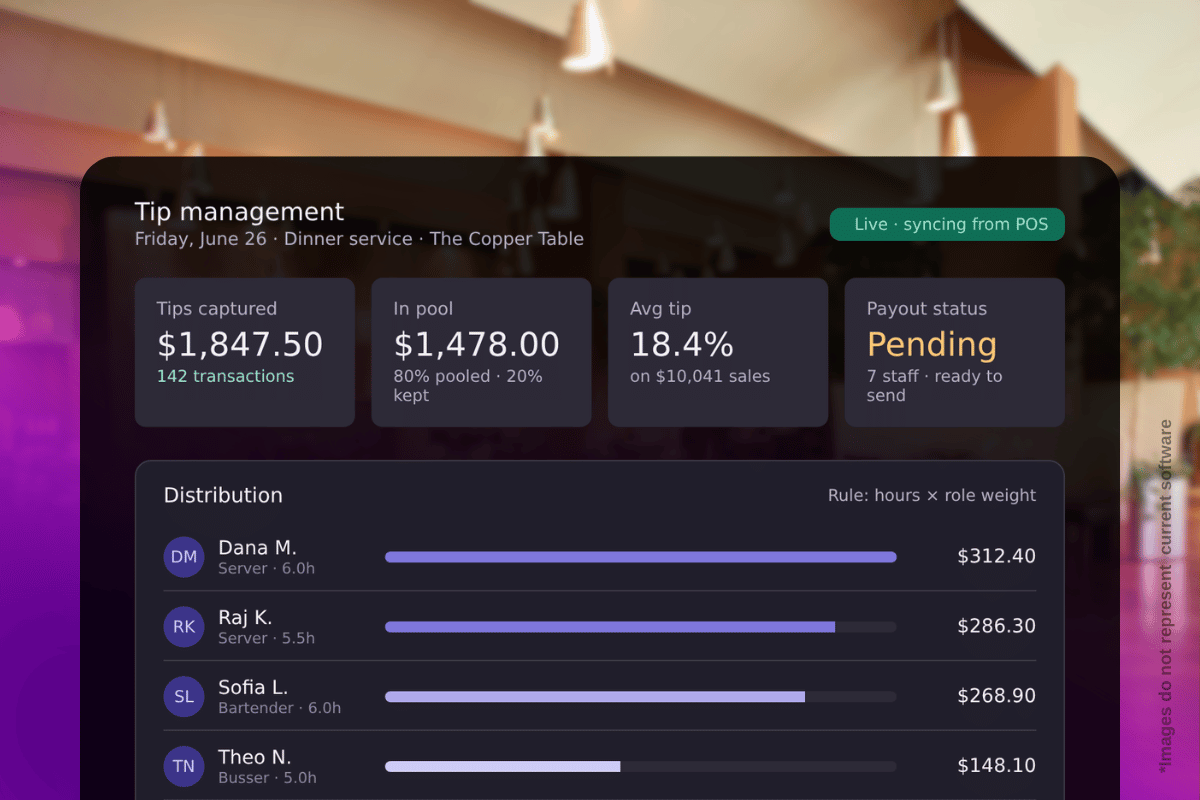
At-a-Glance: Good tip management captures tips accurately at the point of sale, supports tip pooling or sharing fairly, and speeds payouts to staff. Built into your restaurant POS, it reduces disputes, simplifies reporting, and helps you keep good employees.
Tips are central to restaurant staffing, but handling them is often a tangle of manual math, confusion, and frustration. When tip capture is sloppy or payouts are slow, morale suffers and so does your reporting. Modern restaurant software takes the friction out: tips are captured cleanly at the point of sale, pooling or sharing is calculated fairly, and payouts reach staff faster. This guide walks through how thoughtful tip management—integrated with your POS and payments—keeps your team happy and your books clean.
Where Tip Handling Goes Wrong
Tips sit at the intersection of staff morale, accurate accounting, and compliance, which is why getting them wrong creates outsized frustration. A server who feels shorted by a sloppy tip pool, or who waits days for money they earned tonight, is a server already browsing other job listings. The stakes are higher than the dollar amounts suggest.
- Manual math: Hand-calculated pools invite errors and disputes.
- Slow payouts: Waiting days for tips frustrates staff.
- Messy reporting: Disconnected tip records complicate your books and compliance.
What Good Tip Management Looks Like
Modern tip handling fixes these problems by treating tips as data captured at the moment of payment rather than figures reconstructed later. When a guest tips on a tableside device or at the counter, the amount is recorded instantly and flows into whatever pooling or sharing rule you have configured—no clipboard math, no end-of-night arguments.
- Accurate capture: Tips recorded at the point of sale, including tableside payment.
- Fair distribution: Pooling or sharing calculated automatically by your rules.
- Faster payouts: Staff receive tips promptly, not days later.
- Clean records: Tip data flows into reporting for easier compliance.
Setting It Up Right
The payout cadence is a retention lever many operators overlook. The closer your payouts are to the shift that earned them, the more your staff feels respected and the less likely they are to leave over something as fixable as slow money. Pair a sensible cadence with clean records and tip handling stops being a recurring source of friction.
- Define your tip policy—individual, pooled, or shared—clearly.
- Configure your POS to capture and calculate accordingly.
- Choose a payout cadence that keeps staff satisfied.
- Keep tip reporting connected to payroll and your books.
- Communicate the system to staff so expectations are clear.
Clean tip records pay off again at tax and payroll time, when accurate, connected data turns what used to be a reconciliation scramble into a routine export.
When Tip Handling Goes Right: An Example
A full-service restaurant struggled for months with end-of-night tip disputes. Pools were calculated by hand, the math was occasionally wrong, and servers sometimes waited days to receive what they had earned. Morale suffered, and turnover crept up.
After moving tip capture and pooling into their POS, the arguments disappeared. Tips were recorded the moment guests paid—including at the table—pools calculated automatically by the house rules, and payouts sped up. Within a couple of pay cycles, the nightly friction was gone and staff retention improved. The fix was not a raise; it was simply handling tips accurately and promptly.
Keeping Tips Clean for Compliance
Accurate tip records are not only a morale issue—they are a compliance one. When tip data is captured at the point of sale and flows directly into reporting and payroll, you avoid the reconstruction scramble that creates errors and headaches at tax time.
A connected system means the numbers your staff see, the numbers in your books, and the numbers you report all agree. That alignment protects both your team and your business, turning a perennial compliance worry into a routine, automated process.
How Media Payments Group Helps
Media Payments Group configures tip capture, pooling, and reporting inside your restaurant POS, and supports tableside payment so tips are recorded accurately the moment a guest pays. Faster, fairer payouts help you keep good staff, and clean tip records simplify your books—all backed by US-based support when you need a hand.
What sets this apart is the combination: a tailored solution rather than a one-size-fits-all product, transparent pricing instead of rate gimmicks, and US-based support with a direct account representative who actually knows your business. MPG handles every form of acceptance—in-person, card-not-present, ACH, and ecommerce—so as your needs evolve, your payment partner evolves with you instead of forcing a switch. That continuity is what turns a vendor into a long-term partner.
Practical Takeaways
- Set a clear tip policy before configuring your POS.
- Capture tips accurately at the point of sale, including tableside.
- Automate pooling or sharing to avoid disputes and math errors.
- Speed up payouts to keep staff morale high.
- Keep tip records connected to reporting and payroll.
Tip management does not have to be a source of friction. With accurate capture at the point of sale, fair automated distribution, faster payouts, and clean reporting, you keep staff happy and your books in order. Media Payments Group builds tip handling into your restaurant POS and supports tableside payment, backed by US-based support—so tips stop being a monthly headache and start being one less thing to worry about.
Ready to move forward? See how MPG can tailor a solution for your business or contact our US-based team.
Frequently Asked Questions
How does POS tip management reduce disputes? By capturing tips accurately at the point of sale and calculating pools or shares automatically by your rules, it removes the manual math that causes most disagreements.
Can the POS handle tip pooling? Yes. A well-configured restaurant POS can calculate pooled or shared tips automatically based on your policy, keeping distribution fair and consistent.
Why do faster payouts matter? Prompt payouts improve staff morale and retention. Waiting days for earned tips is a common source of frustration that good systems eliminate.
Does MPG help with tip reporting? MPG configures tip capture and reporting inside your POS so the data flows cleanly into your books, simplifying compliance, with US-based support available.