
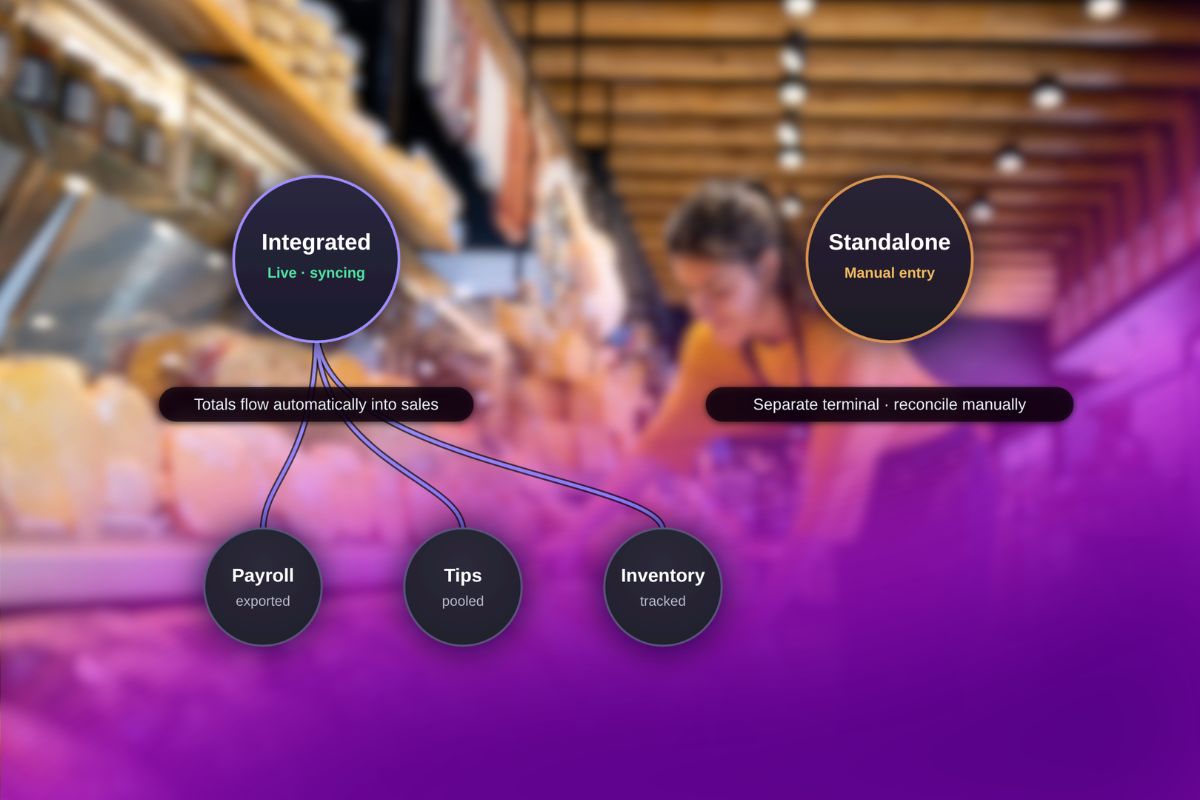
At-a-Glance: Integrated payments run inside your POS so sales and payments stay in sync; standalone terminals process payments separately. Integration usually means fewer errors and easier reconciliation, while standalone can suit very simple or backup setups. The right choice depends on volume and complexity.
When you set up payment acceptance, one decision shapes your daily operations more than almost any other: should payments run inside your point-of-sale system, or on a separate standalone terminal? It sounds technical, but the answer affects how much manual reconciliation your team does, how often errors creep in, and how clean your reporting is. For most growing SMBs, integrated payments inside an all-in-one POS is the smoother path—but standalone still has its place. This guide compares the two honestly so you can choose based on your volume and complexity, not guesswork.
How They Differ
The choice between integrated and standalone sounds like an IT detail, but it is really an operations decision that your staff will feel every single day. The question behind the question is simple: how much manual work are you willing to do to keep your sales and your payments agreeing with each other?
- Integrated: Payment acceptance lives inside your POS; totals flow automatically into sales records.
- Standalone: A separate terminal processes the card; staff re-enter or reconcile totals manually.
The difference shows up most at closeout, when integrated systems reconcile themselves and standalone setups require manual matching.
When Integrated Wins
As volume climbs, the case for integration becomes overwhelming. Re-keying a handful of totals a day is a minor annoyance; doing it across hundreds of transactions is a reliable source of errors, wasted labor, and closeout headaches. Integrated systems eliminate that work entirely by treating the payment as part of the sale rather than a separate event.
- Higher volume: Manual reconciliation gets painful as transactions grow.
- Complex orders: Modifiers, splits, and discounts are handled in one place.
- Cleaner reporting: Sales and payments tie out automatically.
- Fewer errors: No re-keying totals between systems.
The reporting advantage is just as significant. When payments and sales live in one system, your end-of-day numbers reconcile themselves, and the reports you use to run the business actually reflect reality without manual stitching.
When Standalone Makes Sense
None of this makes standalone obsolete. A spare terminal is cheap insurance against an outage, and for a business doing a few transactions a day the simplicity can outweigh the reconciliation cost. The point is to choose deliberately based on your volume, not to default into whatever was easiest to set up.
- Very low volume: A handful of daily transactions.
- Backup acceptance: A spare terminal for outages.
- Temporary or mobile needs: Pop-ups or off-site events.
The Closeout Test: A Comparison
Two shops process similar volume. One runs integrated payments inside its POS; the other uses a standalone terminal beside the register. At closeout, the first shop’s sales and payment totals reconcile themselves automatically—the manager glances at the report and locks up. The second shop’s staff manually match terminal totals against the register, hunting down the inevitable small discrepancies.
Over a week, that manual reconciliation adds up to hours of labor and a steady trickle of errors. Over a year, it is a meaningful hidden cost—paid in staff time, mistakes, and the owner’s peace of mind. The integrated shop simply does not have that line item.
Choosing Based on Where You’re Headed
The right call depends not just on where your business is today but on where it is going. A very small operation might reasonably start with a standalone terminal, but if you expect volume and complexity to grow, integrating from the start saves a disruptive switch later.
It is worth choosing a partner who supports both models under one roof, so you can begin where it makes sense and evolve without changing processors. That flexibility means your payment setup grows with you instead of becoming something you outgrow.
How Media Payments Group Helps
Media Payments Group builds integrated payments into your all-in-one POS so sales and payments stay in sync and closeout is painless—while still supporting standalone or mobile terminals where they fit. Because acceptance is part of one system, you get cleaner reporting, fewer errors, and US-based support that understands the whole setup, not just a piece of it.
What sets this apart is the combination: a tailored solution rather than a one-size-fits-all product, transparent pricing instead of rate gimmicks, and US-based support with a direct account representative who actually knows your business. MPG handles every form of acceptance—in-person, card-not-present, ACH, and ecommerce—so as your needs evolve, your payment partner evolves with you instead of forcing a switch. That continuity is what turns a vendor into a long-term partner.
Practical Takeaways
- Match your setup to your volume—integration pays off as you grow.
- Choose integrated payments to cut manual reconciliation and errors.
- Keep a standalone terminal as a backup for outages.
- Insist that sales and payment reporting tie out automatically.
- Pick a partner who supports both models under one roof.
Integrated and standalone payments both work—but they work for different businesses. Integration keeps sales and payments in sync, reduces errors, and makes reconciliation effortless, which is why most growing SMBs prefer it; standalone still suits very simple or backup scenarios. Media Payments Group builds integrated payments into your POS while supporting standalone where it fits, all backed by US-based support, so your setup matches how your business actually runs.
Ready to move forward? See how MPG can tailor a solution for your business or contact our US-based team.
Frequently Asked Questions
What are integrated payments? Integrated payments run inside your POS system, so card totals flow directly into your sales records without manual re-entry, keeping reporting accurate and reconciliation simple.
Is a standalone terminal ever a better choice? Yes—for very low volume, as a backup during outages, or for temporary and mobile needs. For most growing businesses, integration is smoother.
Does integration reduce errors? Significantly. Because staff do not re-key totals between a terminal and the POS, integrated setups avoid a common source of reconciliation mistakes.
Can MPG support both setups? Yes. MPG builds integrated payments into your all-in-one POS and also supports standalone or mobile terminals where they make sense, with US-based support across the board.