
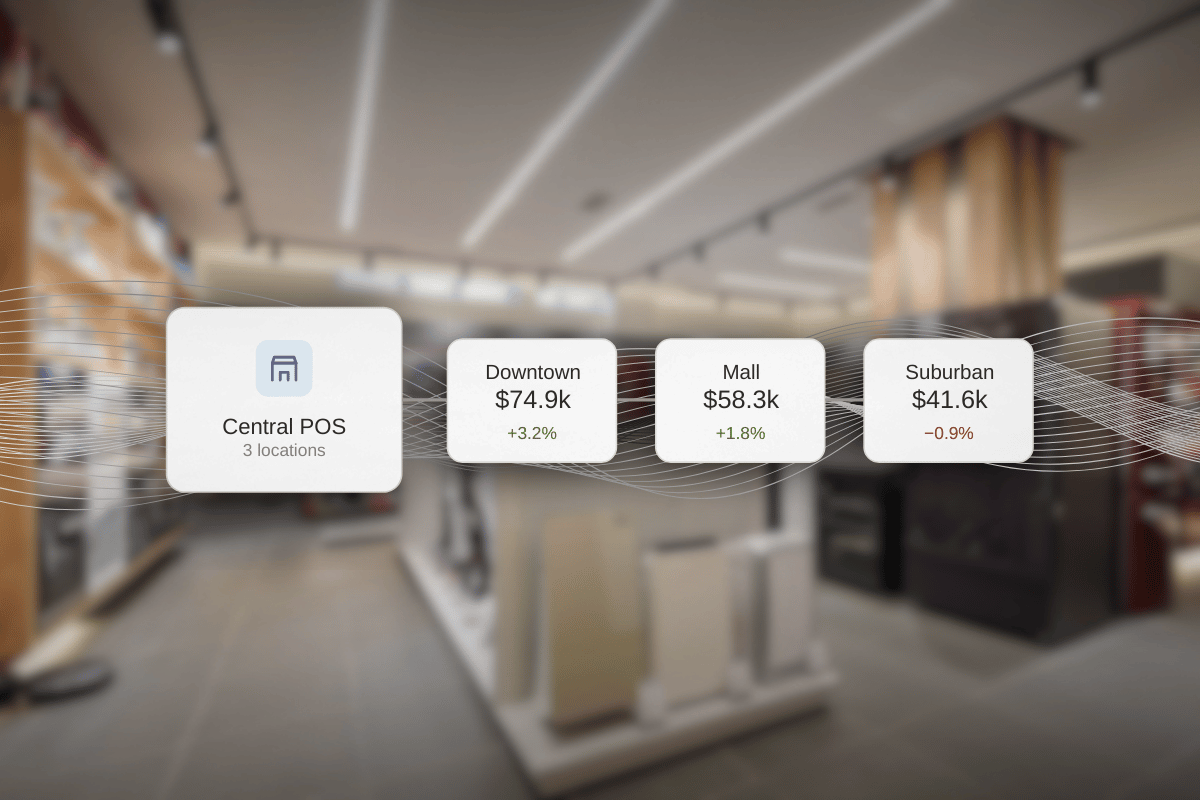
At-a-Glance: Multi-location retailers need centralized payments, consistent pricing, and consolidated reporting across stores. A connected POS lets you manage every location from one view—standardizing acceptance, comparing performance, and scaling without operational chaos.
Opening a second or third location is exciting—until you realize each store runs its own little island of payments, pricing, and reports. Reconciling across locations by hand quickly becomes a part-time job, and inconsistent setups make it hard to know which store is actually performing. The fix is centralization: a connected retail POS system that standardizes payment acceptance and rolls reporting up into one view. This guide covers what multi-location retailers need to manage many stores as smoothly as one—and how to scale without the chaos.
The Multi-Location Challenge
The jump from one location to several is where many retailers discover that their systems were built for a single store. What worked as a manual, one-person process at one register becomes an error-prone scramble across three locations, each closing out differently and reporting in its own format. Centralization is the cure, and the earlier you adopt it, the less painful the growth.
- Inconsistent setups: Each store configured differently creates confusion.
- Manual reconciliation: Combining reports by hand wastes time and invites errors.
- No single view: Hard to compare performance across stores.
What Centralization Delivers
Consistency is the underrated benefit here. When every location runs the same configuration, a customer has the same experience whether they visit your downtown or suburban store, your staff can move between locations without retraining, and your pricing—including any dual pricing program—stays uniform instead of drifting store by store.
- Consistent acceptance: The same payment experience at every location.
- Unified pricing: Update pricing—including dual pricing—across stores at once.
- Consolidated reporting: See all locations in one dashboard.
- Easier scaling: New stores plug into the same system.
A single dashboard changes how you manage, too. Instead of waiting for each store to send numbers, you see them side by side in real time, which makes it obvious which location needs attention and which deserves to be the model for the rest.
Scaling Without Chaos
Scaling smoothly is ultimately about removing the per-store setup tax. When a new location plugs into an existing standardized system, opening it becomes a matter of days rather than a from-scratch project—and your support partner already understands your configuration.
- Standardize your POS configuration across locations.
- Centralize pricing and promotions so they stay consistent.
- Use consolidated reporting to compare store performance.
- Keep omnichannel and in-store data connected.
- Lean on US-based support as you add locations.
Scaling Without the Growing Pains
A regional retailer expanding from two stores to five hit a wall: each new location was set up slightly differently, reports arrived in different formats, and the owner spent weekends stitching numbers together to understand performance. Growth that should have felt exciting felt chaotic instead.
Standardizing every location under one connected POS changed that. New stores now plug into the same configuration, pricing updates push everywhere at once, and a single dashboard shows all five locations side by side. The owner reclaimed those weekends and, more importantly, could finally see clearly which stores were thriving and which needed attention.
Turning Data Into Decisions
Centralized reporting is only valuable if you act on it. With every location in one view, patterns become obvious: a store that consistently outperforms might hold lessons for the others, while a lagging location signals where to focus coaching or inventory adjustments.
The retailers who scale most smoothly treat their consolidated dashboard as a management tool, not just a record. Consistent data across locations turns gut-feel decisions into informed ones—and that clarity is what makes adding the next store feel manageable rather than risky.
How Media Payments Group Helps
Media Payments Group connects your locations under one retail POS system, standardizing payment acceptance and pricing and rolling reporting into a single view. As you add stores, they plug into the same setup—no island-building—so you can compare performance, update pricing everywhere at once, and scale smoothly. Our US-based support grows with you.
What sets this apart is the combination: a tailored solution rather than a one-size-fits-all product, transparent pricing instead of rate gimmicks, and US-based support with a direct account representative who actually knows your business. MPG handles every form of acceptance—in-person, card-not-present, ACH, and ecommerce—so as your needs evolve, your payment partner evolves with you instead of forcing a switch. That continuity is what turns a vendor into a long-term partner.
Practical Takeaways
- Standardize POS configuration across every location.
- Centralize pricing and promotions to keep them consistent.
- Use consolidated reporting to spot top and bottom performers.
- Connect omnichannel and in-store data for a complete picture.
- Choose a system and partner that scale as you add stores.
Multiple locations should not mean multiple headaches. With centralized payments, consistent pricing, and consolidated reporting, you can manage every store from one view and scale without the operational chaos that sinks many growing retailers. Media Payments Group connects your locations under one retail POS, standardizes acceptance and pricing, and backs it with US-based support—so adding stores feels like growth, not gridlock.
Ready to move forward? See how MPG can tailor a solution for your business or contact our US-based team.
Frequently Asked Questions
What does a multi-location POS do? It connects all your stores under one system, standardizing payment acceptance and pricing while consolidating reporting into a single view for easier management.
How do I keep pricing consistent across stores? A centralized POS lets you update pricing—including dual pricing—across all locations at once, rather than configuring each store separately.
Can I compare performance between locations? Yes. Consolidated reporting rolls every store into one dashboard so you can compare sales, identify top performers, and spot issues quickly.
Does MPG support adding new locations? Yes. New stores plug into the same standardized setup, and MPG’s US-based support scales with you as you grow.