
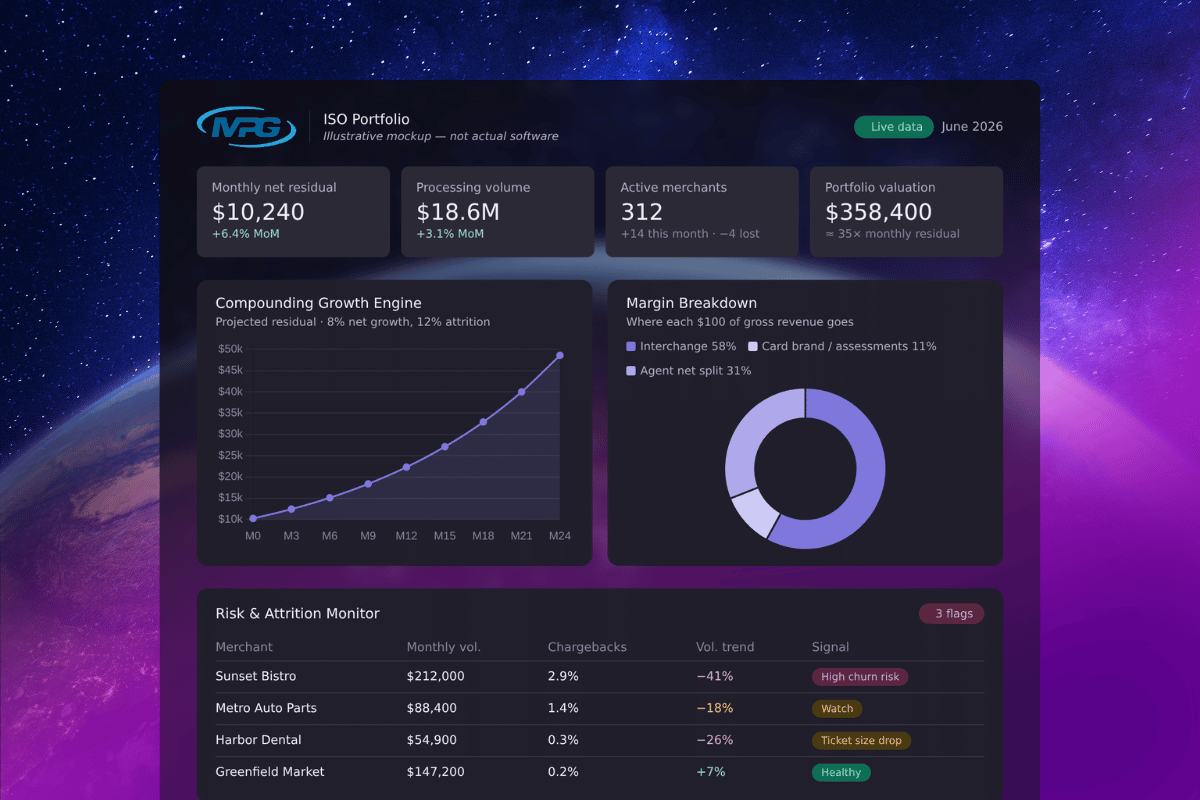
At-a-Glance: A residual portfolio compounds when new boarding outpaces attrition and each merchant stays longer. Focus on retention, healthy account mix, and consistent monthly boarding—not one-time wins—to turn first swipes into durable monthly recurring revenue.
Every agent remembers their first residual check. The agents who build real wealth, though, are the ones who treat residuals like a portfolio rather than a series of one-off deals. A residual portfolio behaves a lot like compounding interest: small, steady additions plus low attrition produce outsized results over years. The opposite is also true—high churn quietly drains months of hard-won boarding. This guide breaks down how ISOs and agents build a residual base that compounds, the levers that matter most, and the metrics worth watching so your monthly recurring revenue keeps climbing even when boarding slows.
Why Residuals Compound (or Erode)
Think of it this way: a portfolio that adds five percent in new residuals each month but loses four percent to attrition grows at barely one percent—while a portfolio that adds the same five percent but loses only one percent grows four times as fast. The boarding effort is identical; the difference is entirely retention. That single insight reshapes how serious agents spend their time.
Your portfolio grows by what you board and shrinks by what you lose. When monthly boarding consistently exceeds attrition, the base compounds. When attrition creeps up, you can board steadily and still stand still. That is why experienced ISOs obsess over retention as much as new accounts.
The Two Forces
- Boarding: New merchants added each month—your growth engine.
- Attrition: Merchants lost to closure, switching, or rate shopping—your leak.
Levers That Drive Durable Residuals
Value beyond rate deserves special attention. When you board a merchant on price alone, you have handed your competition a roadmap: undercut the rate and the account walks. But when that merchant relies on your POS, your reporting, and your responsive support, switching becomes painful and unlikely. Bundling turns a price-shopper into a long-term partner.
- Account mix: A blend of verticals and volumes smooths out seasonal dips and single-account risk.
- Retention: Proactive service and fair pricing keep merchants from shopping around.
- Value beyond rate: Bundling POS and software makes accounts stickier than rate alone.
- Consistency: Steady monthly boarding beats sporadic bursts for long-term compounding.
Consider a merchant boarded with a tailored POS, dual pricing, and a direct support contact. A competitor offering a slightly lower rate now has to convince that merchant to rip out a working system and retrain staff—a far harder sell than matching a number on a statement.
Metrics Worth Tracking
Reviewing these metrics monthly, rather than quarterly, lets you catch attrition early, while you can still intervene with a service call or a check-in. The agents with the most durable portfolios treat this review as a non-negotiable ritual.
- Net residual growth (boarding minus attrition) month over month.
- Average revenue per merchant and how it trends.
- Attrition rate by vertical and by tenure.
- Account concentration—what share of residuals comes from your top accounts.
- Time-to-board and approval rates, which affect how fast you can scale.
A Tale of Two Portfolios
Consider two agents who each board the same number of merchants over two years. The first chases the lowest rate every time and pays little attention after boarding; the second bundles POS and software, checks in regularly, and resolves issues fast. On paper they look identical at the start.
Two years later, the picture is very different. The first agent has watched a steady trickle of accounts leave for the next cheaper offer, so the portfolio has barely grown despite all that boarding. The second agent has lost almost no one—each merchant is embedded in a system they rely on—so every month of boarding has stacked on top of the last. Same effort, dramatically different outcomes, driven almost entirely by retention.
Building Habits That Protect Residuals
Durable portfolios are built on unglamorous routines. The agents who compound their income tend to share a few habits: they review net residual growth monthly, they call merchants before merchants call them, and they treat every service interaction as a retention opportunity rather than a chore.
They also resist the temptation to compete on rate alone. Leading with a complete solution—payments, POS, software, and responsive support—means the relationship is anchored by value, not price. When a competitor calls one of their merchants with a slightly lower number, the merchant has every reason to stay put.
How Media Payments Group Helps
Media Payments Group supports agents with a transparent residual program, bundled software and POS that improve merchant stickiness, and US-based support that keeps your accounts happy after the sale. Because retention is the quiet engine of compounding, our service model is built to reduce the attrition that erodes portfolios—so the accounts you work hard to board keep paying you.
What sets this apart is the combination: a tailored solution rather than a one-size-fits-all product, transparent pricing instead of rate gimmicks, and US-based support with a direct account representative who actually knows your business. MPG handles every form of acceptance—in-person, card-not-present, ACH, and ecommerce—so as your needs evolve, your payment partner evolves with you instead of forcing a switch. That continuity is what turns a vendor into a long-term partner.
Practical Takeaways
- Treat residuals as a portfolio: track net growth, not just new deals.
- Diversify your account mix to reduce concentration risk.
- Bundle software and POS to make accounts harder to displace on price alone.
- Audit attrition by vertical and tenure to find your real leaks.
- Board consistently every month—compounding rewards steadiness.
A residual portfolio that compounds is built on two unglamorous habits: boarding consistently and keeping the merchants you already have. Rate matters, but retention and account mix decide whether your monthly income climbs or stalls. Media Payments Group gives agents the program structure, bundled value, and support to do both—turning first swipes into recurring revenue that grows year over year.
Ready to move forward? See how MPG can tailor a solution for your business or contact our US-based team.
Frequently Asked Questions
What is a residual portfolio? It is the collection of merchant accounts an ISO or agent has boarded, each generating ongoing monthly residual income. Managed well, it behaves like a compounding asset.
How do I reduce merchant attrition? Proactive service, fair and transparent pricing, and bundling sticky tools like POS and software all reduce churn. Merchants rarely leave a partner who solves problems quickly.
Should I focus on boarding or retention? Both, but retention is often undervalued. Boarding grows the top line while attrition silently erodes it—improving retention can lift net residuals without a single new deal.
How does MPG support ISO partners? With a transparent residual program, bundled software and POS to improve stickiness, and US-based support that keeps merchants satisfied after boarding.